End-of-Line Automation
Your line is fast. Your end-of-line is not.
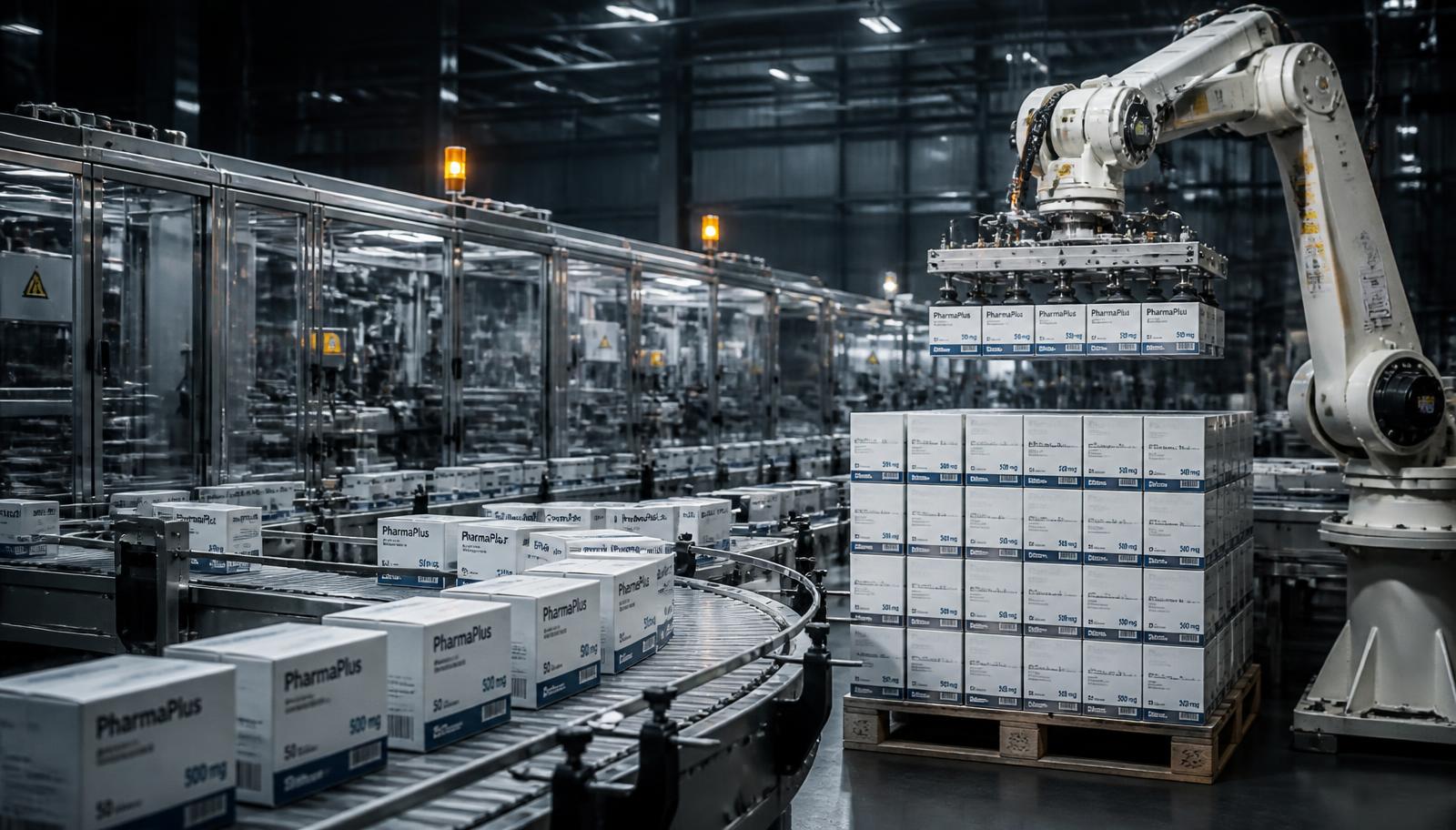
End-of-line automation systems for carton handling, case packing, accumulation, sorting, transfer, palletizing, depalletizing, stretch wrap integration and dispatch — engineered as one continuous flow instead of disconnected machines.
- Machine 01
- Conveyor 02
- Buffer 03
- Robot cell 04
- Inspection 05
- Palletizing 06
- Dispatch 07
The challenge
Where end-of-line loses production.
Most plants do not have a machine problem at the end of line. They have a flow problem between machines.
- Packing and palletizing cannot absorb upstream machine output
- Manual case handling and stacking limits shift consistency
- No buffer between primary packing and dispatch, so a stoppage travels upstream
- Ergonomic and safety exposure from repeated lifting of cases and bags
- Changeover between SKUs and case sizes consumes production time
The solution
One engineered flow from packing to dispatch.
We design the end-of-line as a single system: conveying, buffering, case handling, robotic palletizing, wrapping and dispatch, under integrated controls and safety.
- Accumulation sized to decouple upstream and downstream stoppages
- Case/carton transfer, orientation and grouping ahead of the robot cell
- Robotic palletizing with recipe-driven pattern selection per SKU
- Pallet dispensing, pallet conveying and stretch wrapper integration
- Line-level controls, interlocks and dispatch handshake
How the system works
System operating sequence
- Packed product discharged from the primary packing machine 01
- Conveying and accumulation buffer absorbs speed differences 02
- Grouping, orientation and layer forming per pallet pattern 03
- Robot cell picks and builds the pallet to the selected recipe 04
- Inspection / label verification integrated into the flow 05
- Pallet conveyed to stretch wrapper and dispatch lane 06
System components
What the engineered system includes.
Conveying & accumulation
Grouping & layer forming
Robotic palletizing cell
Pallet handling
Inspection integration
Controls & safety
Industries
Where this is applied.
- Pharmaceutical packaging and dispatch lines
- Food and FMCG high-volume packaging
- Consumer manufacturing and personal care
- Tyre, automotive and component plants
Design inputs
What we need to design the system.
Sharing these upfront lets us respond with a concept instead of a questionnaire.
- Product and case dimensions, weight and pack pattern
- Line speed in cases or cartons per minute, plus number of SKUs
- Pallet size, stack height and stacking pattern requirements
- Available floor layout with obstructions and clearances
- Shift pattern, dispatch method and existing controls platform
Technical FAQ
Questions engineering teams ask us.
Q What is end-of-line automation?
End-of-line automation covers every operation after primary packing: conveying, accumulation, case packing, carton handling, inspection, palletizing, wrapping and dispatch. It is engineered as one integrated flow rather than as individual machines.
Q How do we know whether the end-of-line is the actual bottleneck?
We compare upstream machine output against packing and dispatch capacity across a shift, and study where product waits or where operators are added to keep pace. That study defines whether the constraint is buffering, case handling or palletizing.
Q Can end-of-line automation be added to an existing line?
Yes. Most projects are retrofits. We work from the existing layout, discharge point, controls platform and available footprint, and plan installation around production windows.
Q How is SKU changeover handled?
Pallet patterns and machine parameters are stored as recipes and selected from the HMI. Tooling and guiding are designed for the SKU range defined at concept stage.
Let us evaluate your end-of-line flow.
Send your line layout, product data and current cycle time. We will revert with a preliminary automation concept.